/astrophotography

Old light,
newly caught.

Galaxies, nebulae and star clusters photographed with a small smart telescope. For each one: what it is, where it sits, and how far its light travelled to get here.

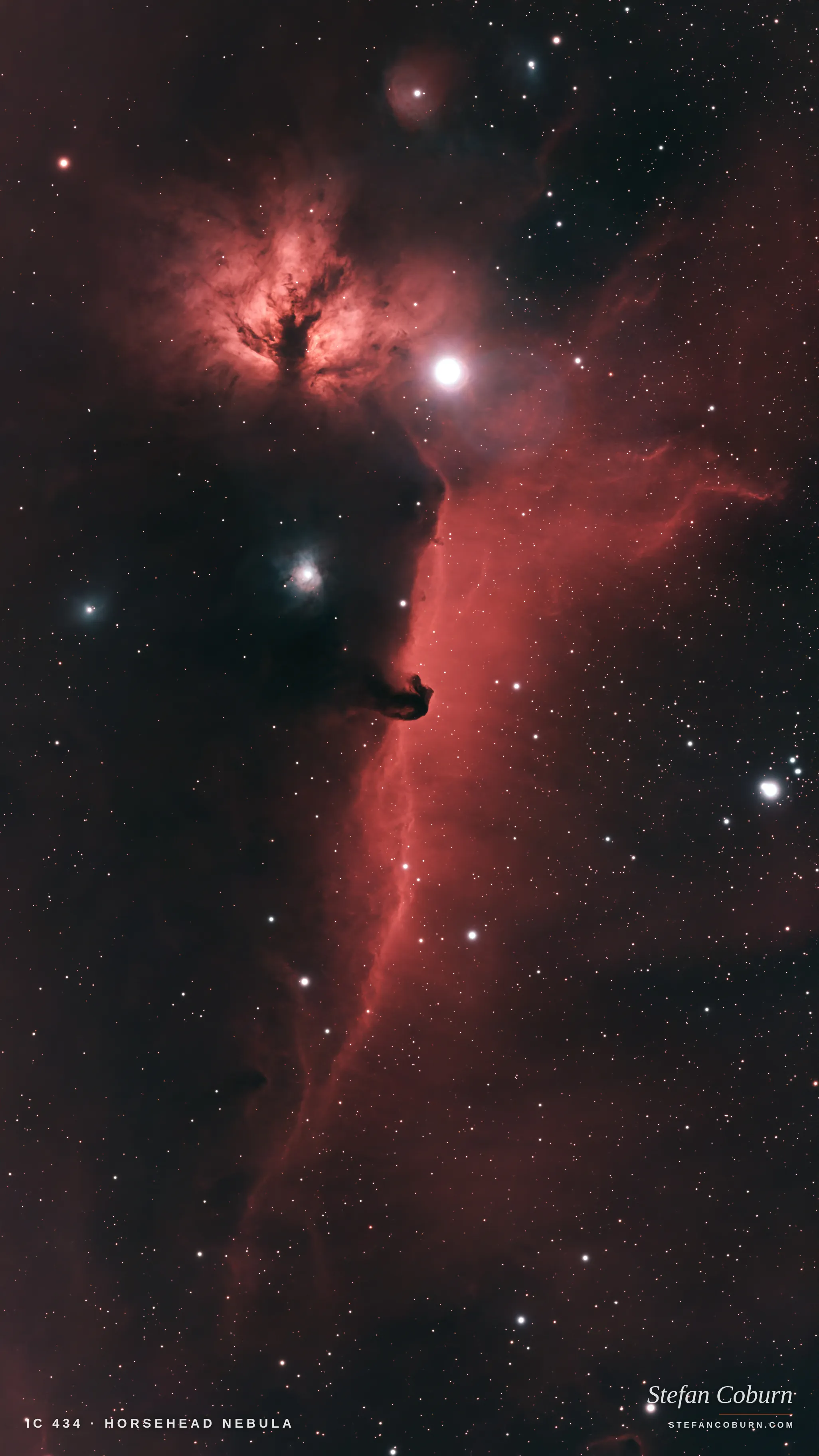
A tall curtain of glowing red gas with a small dark shape like a horse’s head jutting into it. Above sits a brighter orange-pink cloud crossed by dark lanes, next to a very bright white star.
IC 434 · Barnard 33 · NGC 2024

Horsehead and Flame Nebulae

Type
Dark nebula against an emission nebula
Constellation
Orion
Distance
About 1,400 light-years

The Horsehead is the small dark notch halfway down the frame: a cold, dense pillar of dust a few light-years tall, silhouetted against a curtain of hydrogen gas glowing red. Above it, the Flame Nebula is a second cloud lit from within and crossed by dark dust lanes. The brilliant star between them is Alnitak, the easternmost star of Orion’s Belt. Williamina Fleming first spotted the Horsehead on a photographic plate at Harvard in 1888.

Captured 9 November 2026 · Seestar S50 Pro
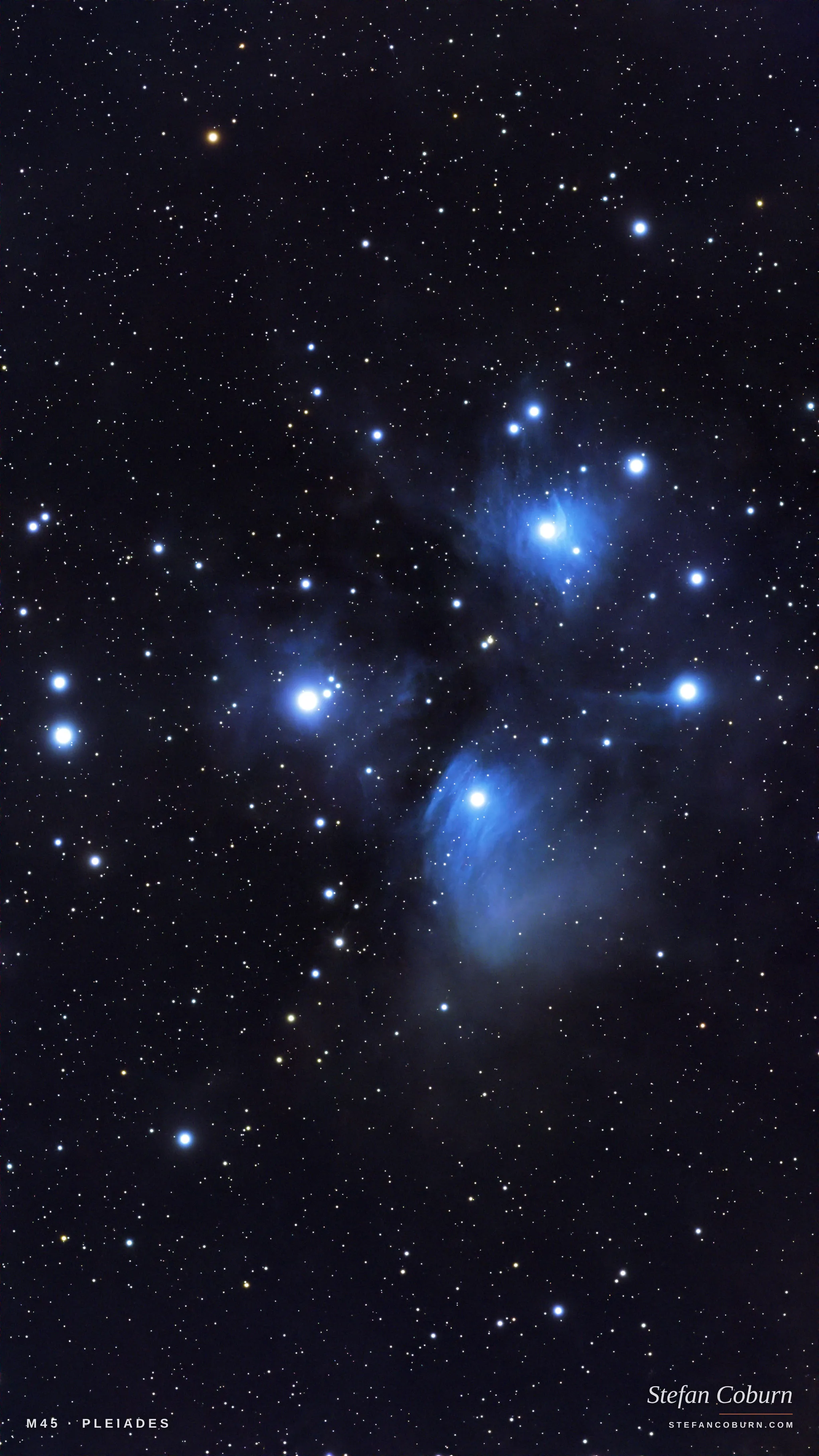
A group of brilliant blue-white stars wrapped in wispy blue haze against a dark sky scattered with fainter stars.
M45 · The Seven Sisters

The Pleiades

Type
Open star cluster with reflection nebula
Constellation
Taurus
Distance
About 440 light-years

A cluster of more than a thousand young stars, born together roughly 100 million years ago and still travelling as a group. Six or seven are visible to the naked eye, and nearly every culture has a name for them; in Japan they are Subaru. The blue haze is not glowing gas. It is a cloud of interstellar dust the cluster happens to be passing through, scattering the blue light of its hottest stars the same way our atmosphere makes the sky blue.

Captured 9 November 2026 · Seestar S50 Pro
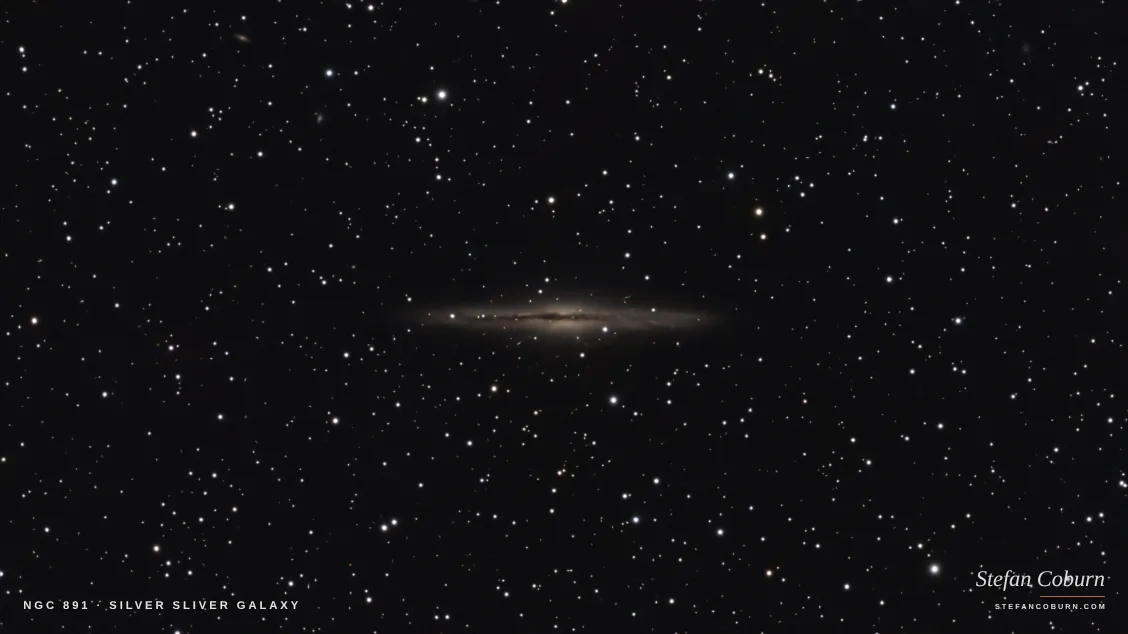
A thin, pale spindle of light with a dark line running along its length, small in the centre of a wide field of stars.
NGC 891 · Caldwell 23

Silver Sliver Galaxy

Type
Edge-on spiral galaxy
Constellation
Andromeda
Distance
About 30 million light-years

A spiral galaxy seen exactly edge-on, so it appears as a thin streak of light split down the middle by a dark lane of dust. It is close to the Milky Way in size and shape, which makes it a fair picture of what our own galaxy would look like from the outside. William Herschel discovered it in 1784. Every other point of light in the frame is a foreground star in our own galaxy.

Captured 9 November 2026 · Seestar S50 Pro
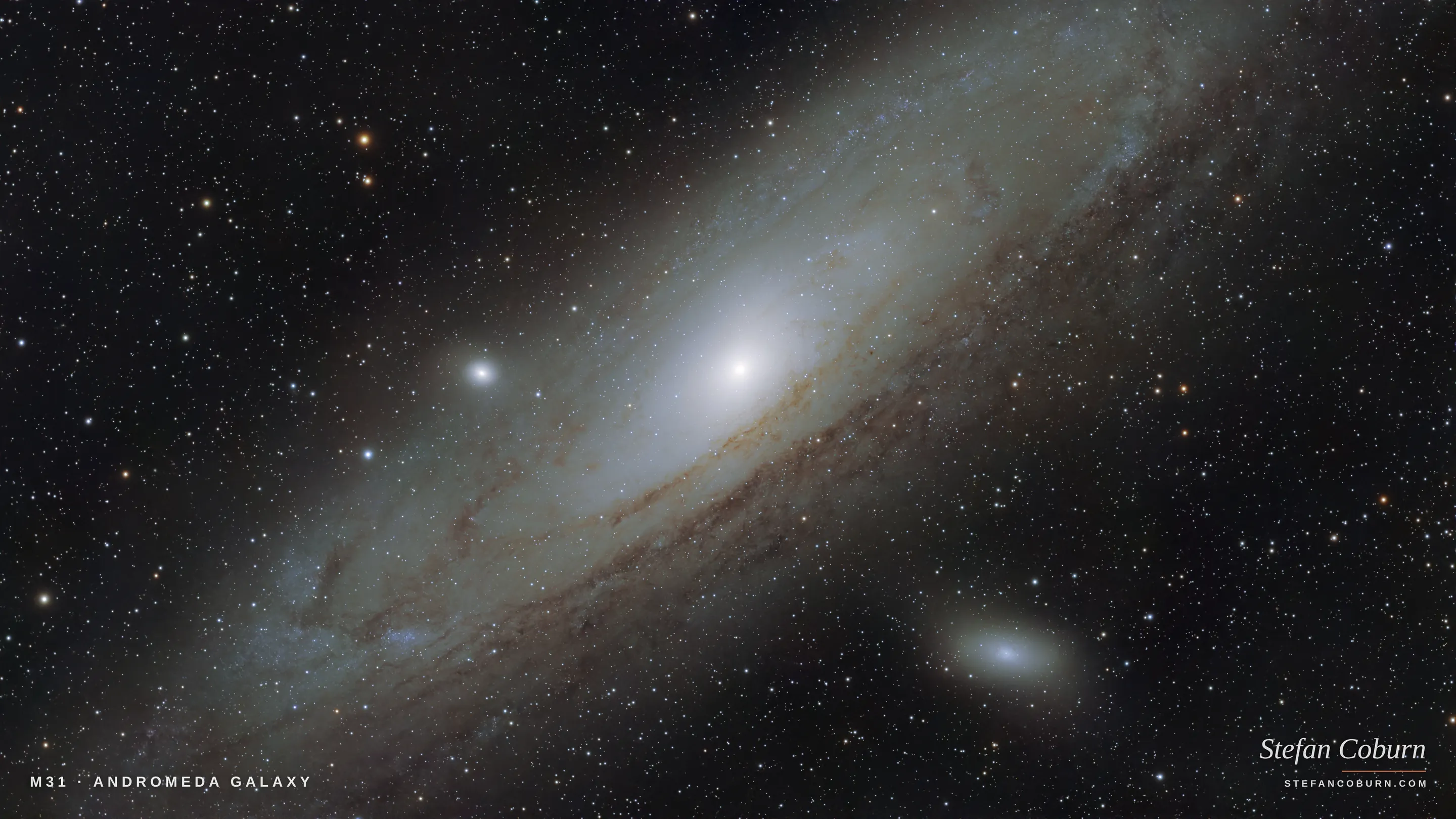
The bright oval core of the Andromeda Galaxy with brown dust lanes spiralling around it, tilted across the frame, and two small fuzzy companion galaxies nearby against a field of stars.
M31 · NGC 224

Andromeda Galaxy

Type
Spiral galaxy
Constellation
Andromeda
Distance
2.5 million light-years

The nearest large galaxy to our own, and the most distant thing most people can see with the naked eye. Andromeda holds several hundred billion stars in a disc more than 150,000 light-years across, so wide that this frame only fits its bright core and inner dust lanes. The two fuzzy patches beside it are its companion galaxies, M32 and M110. The light in this picture left Andromeda before our species existed.

Captured 6 November 2026 · Seestar S50 Pro

How these are made

Every image here was shot with a ZWO Seestar S50 Pro, a self-contained smart telescope about the size of a loaf of bread. It is a 50 mm apochromatic refractor with a 260 mm focal length (f/5.2) feeding a 4K sensor, on a motorised mount that finds and tracks its own targets.

Deep-sky objects are far too faint for a single exposure. The telescope takes a long run of short ones instead. I stack those frames in Stacking Wizard, which aligns them star for star and averages them, so the random noise cancels while the faint signal builds up.

The stacked result goes into Astro Wizard for processing: removing the glow of light pollution, stretching the faint detail into view, balancing colour and taming the remaining noise.