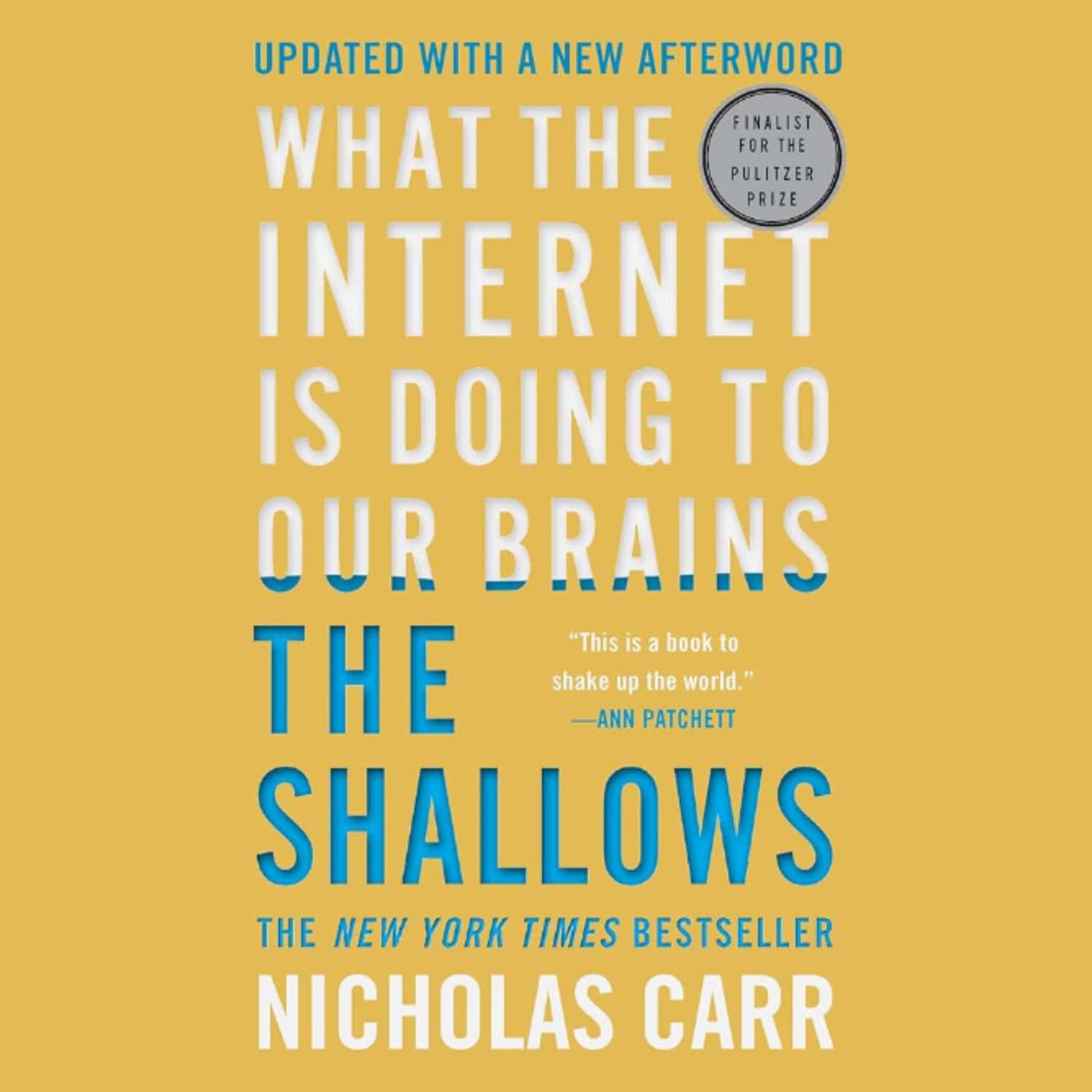
Nicholas Carr’s The Shallows explores one fundamental truth: the brain does not merely process incoming stimuli — it changes dynamically in response to how it is stimulated and engaged. In the modern world, our brains constantly interact with technology (computers, email, apps) and entertainment (streaming, social media, podcasts) in ways radically different from the environment and tools of centuries, or millennia, past. The result is a different brain than that of our grandparents, great-grandparents, and generations before them.
Drawing on research from neuroscience, psychology, and sociology, Carr examines the effects of what he calls “the shallows” — the vast ocean of digital information and entertainment that surrounds us, endlessly accessible yet often lacking real depth.
Adaptation
The human brain is remarkably flexible. While its overall structure includes specialized regions for processing, its neural wiring is highly plastic. Neurons connect, prune, and reconfigure themselves in response to repeated experiences. This plasticity allows for extraordinary variation in human ability, whether in playing tennis, improvising jazz, or watching a film.
Our brains adapt to the tools we use and the experiences we undertake. Consider the differences between typing and handwriting, which extend far beyond words per minute, or the variation in comprehension between reading a printed book and reading the same material on a smartphone.
Carr situates today’s technological shifts in a long history of disruptive tools, from the printing press to the mass proliferation of books. Just as those earlier innovations reshaped cognition, today’s flood of short-form content — email alerts, app notifications, videos measured in seconds, tweets and soundbites — is rewiring us in profound ways.
The research and anecdotes are sobering. Many educators report that the rising generation is losing the ability to read a book from beginning to end.
“I can’t get my students to read whole books anymore.”
The Vanishing Skill of Deep Reading
Reading a book is not merely a pastime; it is a practice. To devote one’s mind wholly to the words on the page — and to the ideas hidden between the lines — requires discipline and focus. For many in Generation Z, those mental pathways have not been reinforced. Instead, their habits have been shaped by an environment of constant stimulation, where information arrives in attention-grabbing, bite-sized packets.
This steady diet of nuggets creates the illusion of learning without the depth of understanding. The most seductive products give us the feeling of improvement without requiring the effort of true mastery. Listening to a podcast on a niche subject may produce a momentary sense of enrichment, yet the engagement is often so shallow that little knowledge is retained or applied.
As neuroscientist Michael Merzenich observed:
“When culture drives changes in the ways that we engage our brains, it creates DIFFERENT brains. [It is hard to imagine life without the Internet and online tools like Google.] THEIR HEAVY USE HAS NEUROLOGICAL CONSEQUENCES.”
Complement or Substitute?
At the root of the question is whether the tools of the mind serve as complements or substitutes. Do our knowledge tools augment and enhance critical thinking, creativity, concentration, and perception? Or do they displace these functions, outsourcing them in ways that promote mental lethargy and the atrophy of essential human abilities?
Steve Jobs once reasoned by analogy that the computer was a bicycle for the mind, a tool that amplified our natural capabilities with far greater efficiency.
“We humans are tool builders, and we can fashion tools that amplify these inherent abilities that we have to spectacular magnitudes.”
This is the tension we must grapple with. Do modern technological tools truly amplify our abilities, or do they replace them? And if they replace them, how do our brains adapt to the loss of functions that once belonged to us? These questions can no longer be ignored in the era of AI tools and large language models like ChatGPT.
But is the bicycle still the right analogy? Riding a bicycle still requires effort — exertion of the legs, strengthening of the body, engagement of the cardiovascular system. The tool extends us, but it does not free us from the work itself. By contrast, what if modern technologies are more like riding in an autonomous car? The passenger expends no physical or mental energy, and the body does not adapt or grow stronger. Indeed, it may regress into a less capable state.
One compelling example is the use of GPS.
GPS vs Brain
The hippocampus, especially the posterior hippocampus, is the region of the brain especially involved in navigation and spacial localization. There is a famous study conduct on London taxi drivers that shows licensed drivers who spent years driving and learning the complex layout of the London streets had enlarged posterior hippocampi compared to control subjects. Their brains had adapted to the mentally strenuous task by devoting a greater brain volume and density to this critical area. We have a generation of drivers who have always used turn by turn instructions from GPS devices or smartphones with GPS-enabled apps. This cohort has diminished structural volume in the hippocampus due to reduced engagement of this area. The “outsourcing” of navigation may attenuate the hippocampal benefits that come from navigation and wayfinding.
One might assume that diminished navigation skills are of little consequence. Yet I would argue that physical maps are deeply connected to conceptual ones. Since their invention, maps have helped us make sense not only of geography but also of abstract relationships. These “mental maps” and the spatial structuring of ideas have often served as powerful engines of insight and discovery. For example, Richard Feynman’s eponymous Feynman diagrams provided a far more intuitive way to visualize subatomic interactions than Julian Schwinger’s purely mathematical derivations of quantum electrodynamics.
Reflection
This fascinating book has made me reflect many times on how deeply I wish to engage with the shallows. I deleted Facebook and got off Instagram. I am active on X (formerly Twitter) but perceive enough maladaptive effects that I am considering how I wish to engage with this platform going forward. Then the big question is how to use LLMs and AI tools to augment and complement my own thinking and mental activities, not to merely outsource them and allow my God-given abilities to whither. This must be a conscious and probably oft-negotiated decision. I must never forget that my engagement with technology and media is in constant feedback bi-directionally with my brain. We are changed by the technology and media we consume. So consume carefully.
Leave a Reply