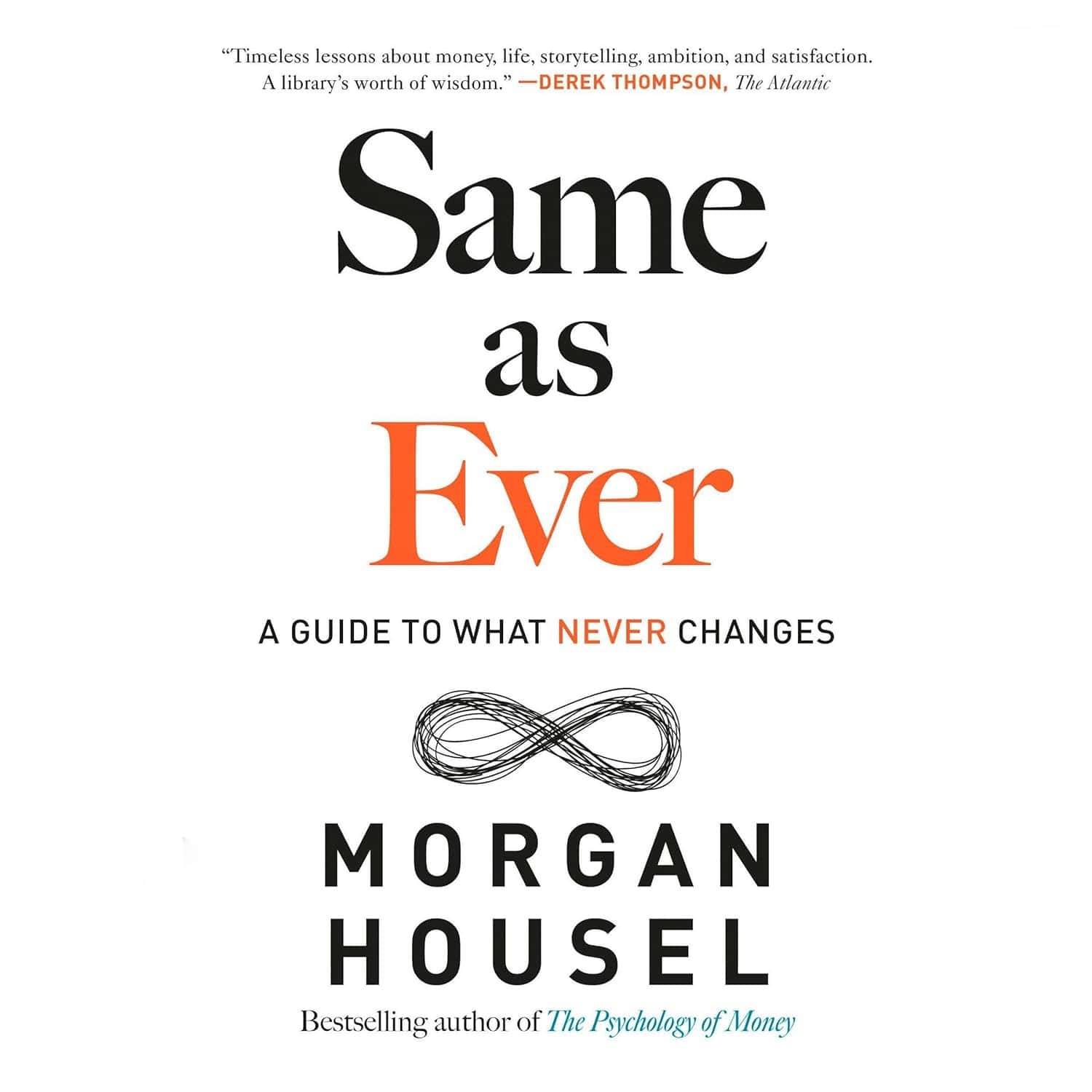
Morgan Housel is a powerhouse of practical financial wisdom. He conveys his ideas through memorable stories and historical examples. I loved his first book The Psychology of Money, and his follow-up, Same as Ever, delivers the same level of impact and clarity on finance, risk, and prudence. The structure of the book is a series of standalone chapters introducing a key concept along with stories to illustrate and drive home the point. Housel is a master storyteller. What follows is my list of key lessons.
- Unpredictability is predictable: small nudges and chance events can dramatically alter the course of history. If this has always been true in hindsight, we should assume the same phenomenon is unfolding around us every day.
- Risk = what remains after you have thought of everything: risk cannot be eliminated, only expected and managed. If you had to predict the biggest news story of the coming year on New Years Eve, you would almost always miss the biggest event of the next 12 months. Who predicted the arrival of COVID, the conflict in Ukraine, 9/11, or the Great Depression? No one. Invest in preparedness, not prediction.
- Happiness = Reality – Expectations: if reality beats what you expected for a given circumstance, you will be happy. If you received less than you expect, you are sad and disappointed. Live in gratitude. Relish the simple beauty of a warm meal, socks on your feet, or a comfortable bed.
- Biz “Greats” are comprised of a constellation of traits: the wealthiest business leaders achieved outsized success by being outliers in a constellation of traits. You cannot aspire to their wealth without also accepting the entirety of their lives. Yes, you want Bill Gate’s or Elon Musk’s wealth. Would you forgo vacations for over a decade, as Gates did, or live on a factory floor and risk insolvency, as Musk has?
- Certainty > Accuracy: people generally are more driven for a desire of perceived certainty than for true accuracy. Statistics and probabilities are some of the accurate language to describe the current and future realities of many situations. Most people prefer the safety of a simple yes-or-no answer. Yet that certainty is an illusion.
- Anecdotes > Statistics: Humans love a good story. People are reluctant to let data get in the way of a good story. In politics the most salient story wins; it does not matter if the facts are not in its favor. It just takes one horrific self-driving car accident to dissuade millions of the technology. This is true even if factually the statistical picture is one where autonomous vehicles are orders of magnitude more safe.
- Calm breeds chaos: When times are stable, people take risks. Those risks eventually trigger a tail event that topples stability. Fear then breeds conservatism, which restores stability — until people feel safe enough to take risks again…. and so it goes. This can explain much of the cyclicality seen in markets and economies.
- Stairs up, elevator down: good news and progress goes slowly, imperceptibly, and takes time to notice. Bad news is immediate, felt, and widely known. Years of progress can be erased in days. Good news is generally things that didn’t happen. Progress is usually quiet; setbacks are loud.
- Optimism/Pessimism – dual virtues: save like a pessimist; invest like an optimist. Plan like a pessimist; dream like an optimist.
- Embrace the suck: Most worthwhile things have a known cost. Learn to enjoy paying that price. Charlie Munger said. “The safest way to get what you want is to try to deserve what you want.” Pay the price. True in relationships, careers, and finances.
- Competitive advantages have a shelf life: No competitive edge lasts forever. Exploit it while it does.
- Incentives = most powerful force in the world: understand the relevant incentives, and you can predict the future. Incentives are the most powerful force in the world. People reliably act according to the incentives in front of them.
Leave a Reply