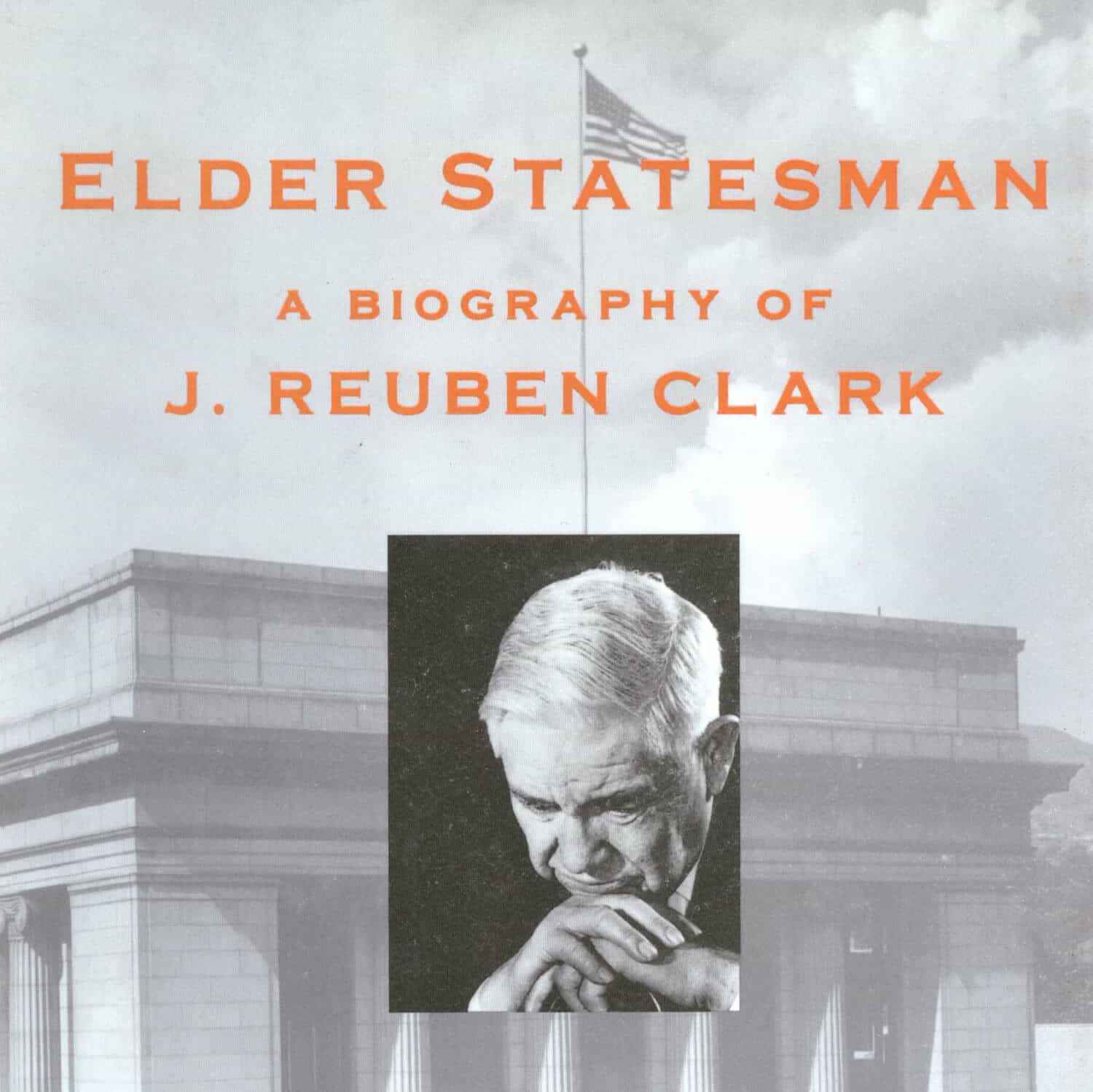
A Biography of J. Reuben Clark
J Reuben Clark (JRC) led a fascinating life and left an indelible mark on The Church of Jesus Christ of Latter-Day Saints. This biography, nearly 600 page long, is impressively researched; the final 200 pages consist of endnotes with sources, quotations, and primary-source context supporting the narrative in the first two-thirds.
Path to Church leadership
Perhaps the most unusual aspect of his life was the trajectory that ultimately led him to the highest presiding council of the Church — the First Presidency. JRC was not called to a position of authority until the age of 62. He had never served as a bishop, stake president, or seventy. Yet the prophet called him to serve as the Second Counselor in the First Presidency, where he would serve under three presidents: Heber J. Grant, George Albert Smith, and David O. McKay.
Although not experienced in presiding authority or church leadership, his call to serve was from God. JRC had accrued other experiences that would prove pivotal to shaping the church as it emerged from relative obscurity and became a world-wide faith. During his tenure, the Church would grow and establish itself throughout the globe. His talents and expertise were in the areas of law, politics, governance, and administration. He would use these God-given talents and experiences to shape the church with his unique perspective. He had served as the US Under Secretary of State and US Ambassador to Mexico. He was trained in law and had an aptitude for study and research. He served the Lord in the same style he had served his country. He was known for studying church matters deeply, coming to meetings and councils with prepared briefs outlining relevant background, doctrine, history, and delineating his prayerfully considered position. This rigor would outlast his service.
Abrahamic sacrifice
Church service is rarely comfortable and often demands a submission to the Lord. JRC a talented and ambitious public servant who envisioned serving in the highest echelons of government as a state senator or possibly a Vice President. At age 55, he was forced to reckon with the tension between worldly ambition and Christlike service. It was no easy decision, but he felt inspired to lay aside those ambitions and be wholly available to the Lord. In 1925, he accepted a call to the Young Men’s Mutual Improvement Association general board. As he wrote to his close friend Fred Morris Dearing:
“I thoroughly enjoy living out here in the desert wilderness and while I miss the fleshpots of Egypt and sometimes I am in a sad need of a helping from them, I am still quite willing to forgo the mere lucre for the sake of the real life which I am able to live.”
I believe our Heavenly Father has a sense of humor and isn’t afraid to subvert expectations. Despite striving and falling short of his ambitions and leaving them at his peak of influence and experience, after being called to serve in the church, there came many opportunities for position, power, and prestige. These would be thrust upon him. He would go on to serve as:
- 1928-29 7th United States Under Secretary of State
- 1930–33 Ambassador Extraordinary and Plenipotentiary of the United States to Mexico
- 1933 Delegate of the United States to the Seventh International Conference of American States (Pan-American Conference), Montevideo, Uruguay
- 1933 Elected director, Equitable Life Assurance Society of the United States, New York City
- 1936 United States representative on Committee for the Study of International Loan Contracts (League of Nations)
- 1950 Elected member, board of trustees, the Roosevelt Memorial Association
His life is a testament to the scripture, “Wherefore, dispute not because ye see not, for ye receive no witness until after the trial of your faith.”
Legacy
Very little can be wholly attributed to any single individual; however, here is a list of many of the lasting marks JRC left upon The Church of Jesus Christ of Latter-Day Saints:
- JRC was a staunch advocate for an official church policy of political neutrality. The pulpit is not the place for the church or its leader to opine on political parties. He argued that General Authorities should not simultaneously serve as high-ranking government officials, as in the case of Apostle and U.S. Senator Reed Smoot.
- JRC in principle started Church Correlation whereby official church materials and publications would be thoroughly reviewed and approved to keep the doctrine pure. He championed the establishment of the “Literature Committee” in 1940 and the subsequent “Committee on Publications” in 1944. These committees would help set and maintain standards for publication of official church materials for use in church organizations for instruction.
- JRC dealt with the apostates who were continuing to practice polygamy. He authored sharp and unequivocal denunciation of the practice on behalf of the First Presidency in 1933.
- JRC was critical in architecting and establishing the Church’s Welfare Program. In the Great Depression and thereafter, JRC advocated for seeking to help our brothers and sisters before they turned to the government for assistance. This help was predicated on a program of service, labor, work coordination, and improvement. The church established farms and canneries with the dual mandate of providing work opportunities to beneficiaries and directing providing material aid to those in need.
What is old is new
One of history’s great lessons is that the tensions and conflicts of human experience endure across time. Reading about the political polarization of the 1930s, I could not help but think of the United States in 2025. Some Church leaders struggled to understand how faithful Latter-day Saints could support Franklin D. Roosevelt, whom they regarded as a radical. Yet FDR carried Utah with more than 60% of the vote. His programs and expansion of the federal government were seen as subversive to the Constitution and core American principles of governance.
Regardless of personal politics, I think all can agree that today we struggle to empathize and understand good faith members of the opposing political party. It is hard to provide a charitable interpretation of their (obviously) horrendous actions and motives. These were substantial events and topics during JRC church service.
Additionally, JRC was opposed to American intervention in the European conflict that would be known as WWII. I see similar threads to those who oppose American support and equipment being sent and used in Ukraine and Israel. Your personal politics is not the important point, but rather that these are thorny issues that good people can (and WILL!) have disagreements about. We must be able to preserve a respect and decency to our political opponents. At a fundamental level, we share common attributes of love and identity that finds its expression in often diametrically opposed actions.
Leave a Reply